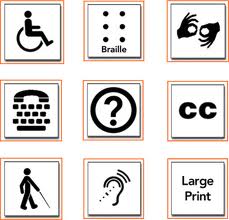
There are many different types of Disabilities, but here are a few of them:
Attention Deficit Disorder/Attention Deficit Hyperactivity Disorder (ADD/ADHD) - ADD and ADHD are neurological conditions affecting both learning and behavior.
http://web.jhu.edu/disabilities/faculty/types_of_disabilities/adhd.html
Blindness/Low Vision-
The following terms are used in an educational context to describe students with visual disabilities:
- "Totally blind" students learn via Braille or other nonvisual media.
- "Legally blind" indicates that a student has less than 20/200 vision in the more functional eye or a very limited field of vision (20 degrees at its widest point).
- "Low vision" refers to a severe vision loss in distance and near vision. Students use a combination of vision and other senses to learn, and they may require adaptations in lighting or the print size, and, in some cases, Braille.
http://web.jhu.edu/disabilities/faculty/types_of_disabilities/blindness.html
Brain Injuries- Brain injury may occur in many ways. Traumatic brain injury typically results from accidents; however, insufficient oxygen, stroke, poisoning, or infection may also cause brain injury. Brain injury is one of the fastest growing types of disabilities, especially in the age range of 15 to 28 years.a
http://web.jhu.edu/disabilities/faculty/types_of_disabilities/brain.html
Deaf/Hard of Hearing- Students who are deaf or hard of hearing require different accommodations depending on several factors, including the degree of hearing loss, the age of onset, and the type of language or communication system they use. They may use a variety of communication methods, including lip reading, cued speech, signed English and/or American Sign Language.
http://web.jhu.edu/disabilities/faculty/types_of_disabilities/deafness.html
Learning Disabilities- Learning disabilities are neurologically based and may interfere with the acquisition and use of listening, speaking, reading, writing, reasoning, or mathematical skills. They affect the manner in which individuals with average or above average intellectual abilities process and/or express information. A learning disability may be characterized by a marked discrepancy between intellectual potential and academic achievement resulting from difficulties with processing information. The effects may change depending upon the learning demands and environments and may manifest in a single academic area or impact performance across a variety of subject areas and disciplines.
http://web.jhu.edu/disabilities/faculty/types_of_disabilities/learning.html
Medical Disabilities- Other disabilities include conditions affecting one or more of the body's systems. These include respiratory, immunological, neurological, and circulatory systems.
http://web.jhu.edu/disabilities/faculty/types_of_disabilities/medical.html
Physical Disabilities- A variety of physical disabilities result from congenital conditions, accidents, or progressive neuromuscular diseases.
http://web.jhu.edu/disabilities/faculty/types_of_disabilities/physical.html
Psychiatric disabilities- Psychiatric disabilities refer to a wide range of behavioral and/or psychological problems characterized by anxiety, mood swings, depression, and/or a compromised assessment of reality.
http://web.jhu.edu/disabilities/faculty/types_of_disabilities/psychiatric.html
Speech and Language Disabilities- Speech and language disabilities may result from hearing loss, cerebral palsy, learning disabilities, and/or physical conditions. There may be a range of difficulties from problems with articulation or voice strength to complete absence of voice.
http://web.jhu.edu/disabilities/faculty/types_of_disabilities/speech.html
www.jhu.edu
